On February 6, 2026, the Federal Judicial Center, the research and education arm of the federal judiciary, omitted (i.e., withdrew) a chapter from the newest edition of its reference manual on scientific evidence that addressed climate change. The climate chapter had been criticized as a work that “undermines the judiciary’s impartiality and places a thumb on one side of the scale. It does so even as these issues are pending before the Supreme Court and other parts of the federal judiciary.”
The Back Story – The Reference Manual and Its Climate Chapter
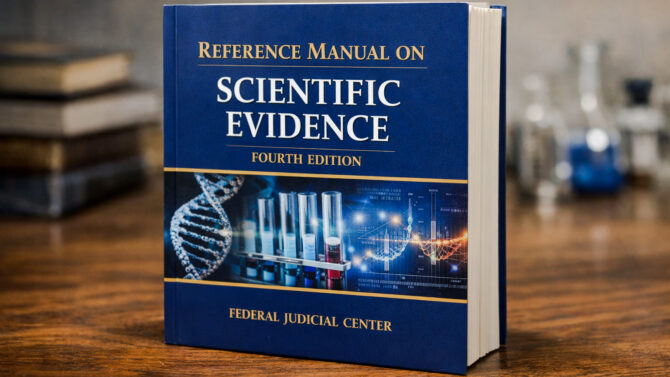
By way of background, on December 31, 2025, the Federal Judicial Center, the research and education agency for the federal courts, published its first update in 15 years of the manual on scientific evidence. The 1,682 page guide, called the “Reference Manual on Scientific Evidence,” [ .. this is an unofficial link to the original document] included more than 90 pages describing climate change science.
The manual, little known to the public but of huge import in the judiciary (.. “it has been provided to more than 3,000 federal judges and even more state court judges”), begins with a foreword by Supreme Court Justice Elena Kagan, who writes that while judges are “generalists” who often learn about scientific issues “through the adversary process, . . . sometimes it also helps to have a dispassionate guide.” Judges will do their job better when they learn from the technical expertise of scientists, she writes, and “the law will become stronger as it further reflects sound science.”
The paragraph concludes this “sometimes occurs as a result of strategic manipulation from stakeholders who stand to be harmed if the public were to understand the true state of scientific consensus,” such as in the cases of “tobacco, ozone depletion, and climate change.”
So, is anyone who disagrees on climate akin to those who deny that cigarettes cause cancer? A footnote to the section refers readers to “Michael E. Mann, The New Climate War: The Fight to Take Back our Planet” and “Naomi Oreskes, The Scientific Consensus on Climate Change,” who each, in their own way, have been embroiled in controversy over criticism of ‘climate change deniers.’
The manual’s Reference Guide on Climate Science was written by Jessica Wentz and Radley Horton of Columbia University. Ms. Wentz is an associate director at the Sabin Center for Climate Change Law, whose “core mission” is to “develop and promulgate legal techniques to combat the climate crisis and advance climate justice.” They are partisans.
Controversy and Calls for Withdrawal
This attempt at what was characterized as one sided advocacy caught the attention of many, including this author. Significantly on January 14, 2026, U.S. House Judiciary Committee members Jim Jordan (R., Ohio) and Darrell Issa (R., Calif.), wrote to the Administrative Office of the Courts the “scientific” contributions to the manual “appear to have the underlying goal of predisposing federal judges in favor of plaintiffs alleging injuries from the manufacturing, marketing, use or sale of fossil fuel products,” they wrote, questioning what they termed an exercise in judicial indoctrination. They further describe, “improper attempts by the Environmental Law Institute (“ELI”) and its Climate Judiciary Project (“CJP”) to influence federal judges ..”
Article III’s Promise of an Impartial Tribunal
On February 2, 2026, twenty seven state Attorneys General, including those from West Virginia, Florida, Idaho, Montana, New Hampshire, Texas, and Wyoming, signed a letter objecting to the manual’s bias and asked that the chapter be withdrawn. The Ag’s wrote, “Article III guarantees every litigant – whether a State, an energy company, or an environmental group – the right to an independent and impartial tribunal. When the judiciary’s own research arm predetermines contested questions in active litigation, that guarantee becomes meaningless.”
On February 6, 2026, Judge Robin Rosenberg, director of the Federal Judicial Center, wrote to West Virginia Attorney General John McCuskey saying, “I write to inform you that the Federal Judicial Center omitted the climate science chapter ..” from the manual’s fourth edition. The letter did not explain. A footnote in the appendix only says that “The FJC omitted ‘Reference Guide on Climate Science’ on 2/6/2026.”
Real Word Implications and Ongoing Legal Matters
And lest one think this is simply an academic debate among attorneys or judges for that matter, to the contrary when the current Administration announced last Thursday, after EPA’s Reconsideration of the GHG Endangerment Finding, it is now moving to repeal the Obama Administration scientific findings that serve as the legal basis for federal regulation of greenhouse gases, one may be assured that repeal will be challenged in the courts (.. quite possibly in front of a judge that will have the reference manual on his desk?).
It should be lost on no one that while the climate change chapter was removed, the foreword to the manual, authored by Justice Elena Kagan, remains with its nod to the now excised chapter.
The Role of the Judiciary and Final Thoughts
The judiciary’s role is not to cede to political currents but to ensure that when science enters the courtroom, it does so through processes that respect both its complexity and its contested nature. In reaffirming that principle, the Federal Judicial Center’s action in omitting the partisan chapter is not just defensible; it is an affirmation of judicial integrity at a time when integrity is being questioned in many of society’s institutions.
The Wall Street Journal editorial board wrote in “A Failed Climate Coup in the Courts” that “public accounting of how that [chapter] happened would be useful.” Maybe so?
Scientists should be outraged at the attempt to hijack science. Lawyers and judges should be heard to complain about this effort that would have eroded confidence in the judiciary’s neutrality. And all Americans should want an explanation of how the judiciary tried to place a thumb on one side of the scale.
The now revised final Reference Manual on Scientific Evidence, reduced to 1,662 pages, is here.
_________________________
Join us for the next in our webinar series at the Intersection of Business, Science, and Law, “Everything You Always Wanted to Know about Environmental Law (But Were Afraid to Ask)” on Tues, Feb 17 at 9 am. The webinar is complimentary, but you must register here.